Art of Darkness
-Unbroken Hope by Michael Wells
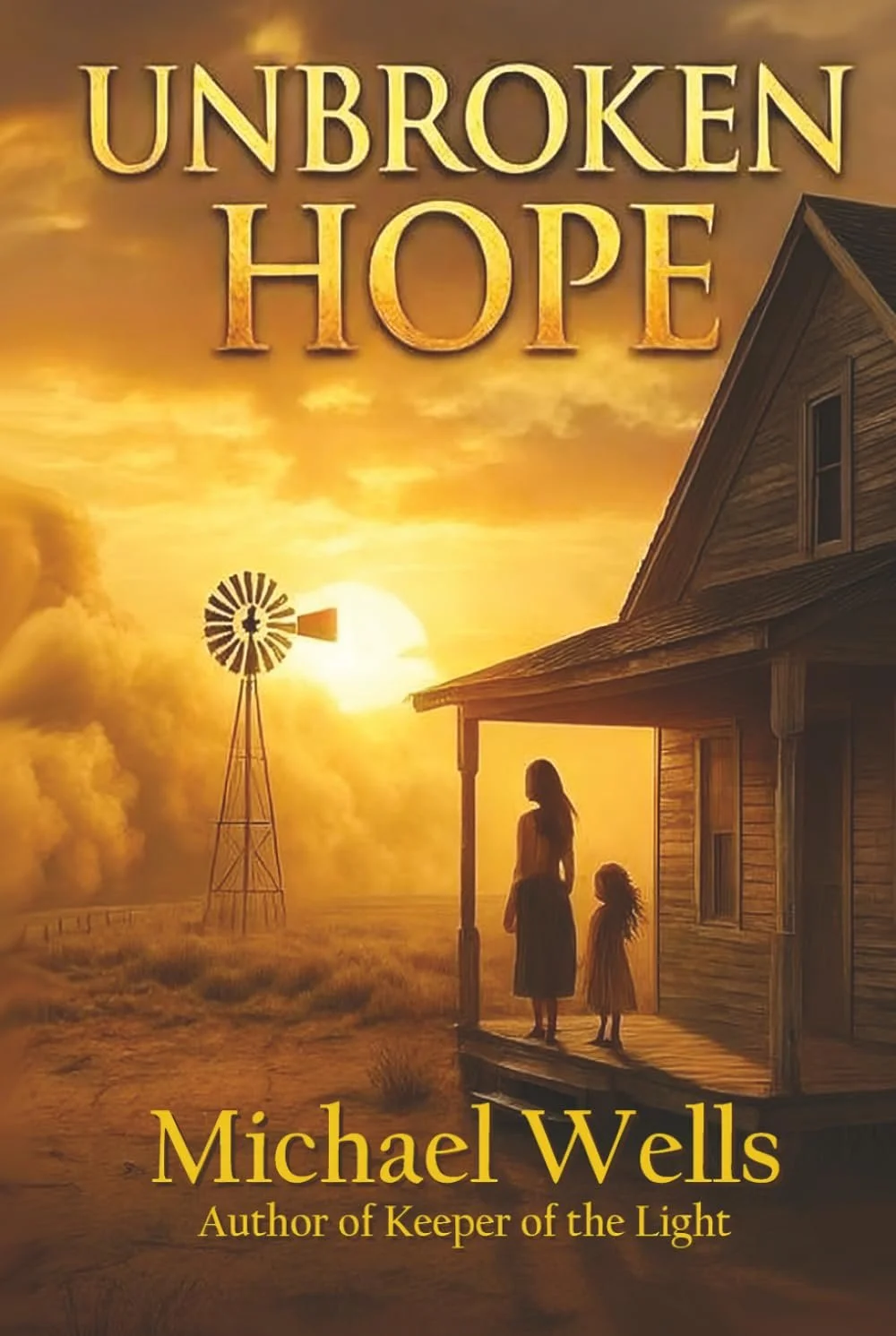
‘A Dust Bowl mother’s fight for survival. A daughter’s unbreakable spirit. A journey that refuses to surrender to despair.’
This sweeping story is a fictionalised account of the author’s maternal grandparents’ lives and his mother’s early years. The novel is wide ranging, beginning during the dust bowl which ravaged the plains of Oklahoma during the thirties. Migrating to California, the perceived land of milk and honey, the story at first follows Clay, Wells’ grandmother’s partner of the time, on his journey west in his Model T Ford. The author’s grandmother, Erma follows on behind with three-year-old Barbara-Jean, Wells’ mother in tow, jumping the railroad in a high-risk effort to catch up with Clay.
This first section of the story unfolds languidly, the unhurried narrative slowly building. It rather reminded me of French cinema from the golden age where not a great deal seems to happen – and I don’t mind this relaxed approach because the focus is on the characters instead. Here, Wells directs his attention toward the detail, the minutiae: what his character’s eat – which isn’t much – conversations about small, even trivial matters played out in full, with the local dialect of the period well presented. There is time too for great observational detail, firmly rooting the narrative’s time and place: a perfect description of a gasoline pump with its iconic glass globe set atop it – the author goes a little further even to explain its operation in loving detail. Wells’ research is evident and it’s this degree of detail which gives the story its life and enables the early part of the novel not to rely so much on drama yet remain highly readable. The writing is kept close to the characters’ experiences and is crisp, polished. There is also a delicacy to the prose: the death of a child is treated with a degree of care which foretells what is to come.
The mid-section reveals an interesting structure to the novel: After the first part which follows two converging narrative threads, the mid-section unusually repeats this construct. Erma and Barbara-Jean settle into life together in Los Angeles, whilst Vince, Erma’s new husband and surrogate father to Barbara-Jean, is drafted into the army to fight overseas for his country in the developing world war taking place in North Africa and Europe. Their poignant parting scene is yet another example of how deftly Wells handles writing intensely emotional scenes. With Vince gone, Erma’s desperate longing for him to be home is perfectly conveyed. The relationship and interactions between mother and daughter are extremely well played. The difficulty for Erma to deal with her own heartbreak at Vince’s absence whilst simultaneously needing to protect and reassure her daughter is highly charged on the page. Wells’ phrasing is spot on with masterfully delivered gems such as, in describing Erma’s difficulty in balancing the practicalities of keeping a home together and her daughter safe amid the uncertainty of wartime, it being ‘a careful dance between survival and despair.’
However, I would have liked more detail here. Sense of place isn’t so well presented as it is elsewhere and the description of the city and Erma’s day to day life within it felt thin to me: her workplace for instance had great potential to have been more fully realised. As a migrant child, Barbara’s difficulties integrating into the school community are finely observed and the unfolding story of this period of her life hit my heart heavily.
Meanwhile, Vince’s ordeals of war are depicted with confidence, descriptions of the various locations are nicely written and the battle scenes realistically portrayed. At times though, I felt the conveyance of emotion attached to his experiences of war lacked the intensity which the author easily manages to express in the quieter Los Angeles passages. I wonder if this might be because Vince’s character isn’t introduced fully enough to the reader prior to his being drafted, and so our sympathies for him are lesser than for the characters he leaves behind in Los Angeles. I wish I knew him a little better, that his character was more fully formed to provide a solid foundation for his wartime experiences to be laid upon.
The historical overview of the second world war in Europe is effectively communicated; the period has clearly been well researched by the author which shows in the skilfully rendered backdrop. A standout scene comes amid a break in the fighting, where we are treated to a highly personal depiction of the experience of liberation from German occupation. Taking place in a Sicilian village, the honesty of this scene feels very much like it must have been drawn from an actual happening. If so, then I like it for this reason: a returning soldier’s story, relayed to his family after the war has ended – a poignant, anecdotal piece of history woven into the novel. And if it is in fact the author’s invention, then it’s a superb piece of imaginative writing. There’s another, similar scene which takes place later in Paris, that has similar qualities but it’s the delicacy in the telling of the Sicilian scene that steals it for me.
Drama emerges during this mid-section and continues to ramp up as the novel develops through into the second half of the book. Whilst the repercussions of the dramatic events told are hugely significant, the moments themselves are sometimes comparatively short-lived. It’s a minor niggle but I would have liked them to have been more expansive: a sense of foreboding to have been built-up ahead of time, and for the reader to stay with those events for longer before the story moves on.
The latter section centres first on Barbara’s tragic pre-teen years. It’s a riveting but heart-breaking read, even more so for following on the back of everything which has gone before. Some of the content here is highly emotive and I found it at times difficult to read. Finally, we follow Barbara as she enters her teenage years, and her hope is at last realised.
This multi-faceted novel is by no means an easy read from an emotional perspective but is certainly rewarding none the less. In sharing a personal memoir through skilfully crafting it into an artful work of fiction, Wells has succeeded in producing a highly engaging historical novel which confronts head-on the human cost of war, and the implications to individuals brought by natural disasters. Loss is examined in a very personal way and the difficulties of resettlement experienced by migrant families, especially by their children, is brought to light. Rich with tragedy, Unbroken Hope is an emotional journey into the very heart of darkness but ultimately, and crucially, out the other side.
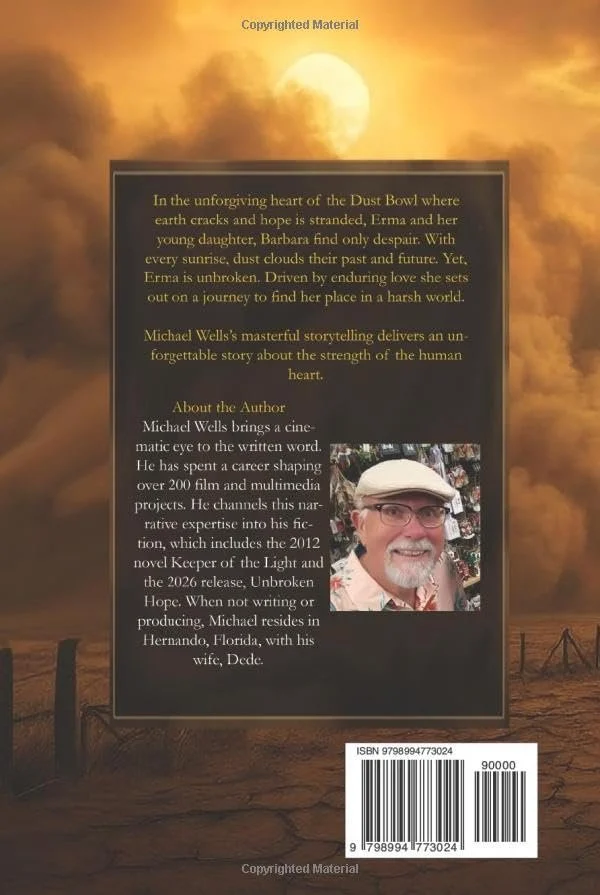
About the author

‘I have been fortunate to spend the last 20 years doing exactly what I love: telling stories and building businesses. From being named one of the world's Top 100 Multimedia Producers to selling five different startups, I’ve learned that life is about constant reinvention.
My career began in the fast-paced world of Northern California film production and evolved into the digital frontier of e-Commerce. Along the way, I earned my MBA, produced over 200 multimedia titles. Today, I channel that expertise into MWells Media, my technology consulting firm.
But my heart has always been in writing. Following the success of my first novel, Keeper of the Light, I am thrilled to announce the release of my latest work, Unbroken Hope, available now on Amazon and in fine bookstores.
I now call Hernando, Florida home, where I live with my wife, Dede.’
-Michael Wells
Buy Unbroken Hope